
The Desert as a Contest of Endurance
The Horse and His BoyThe desert crossing tests the fugitives physically and psychologically, turning a mapped route into an ordeal that demands cooperation and judgment.
increasing Bearing strength in each event
 decreasing
Bearing strength in each eventdecreasingA Route Chosen by Knowledge
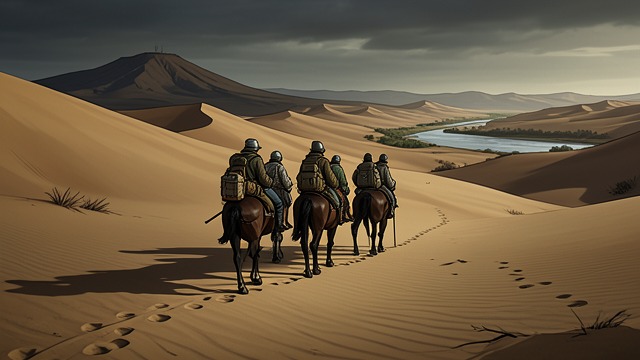
Finding a way through
The raven’s information
Shasta remembers Sallowpad’s account of a hidden valley reached by keeping Mount Pire ahead. That route offers a river beyond the desert, unlike a direct crossing that would leave travelers without reliable water.
Risk in the map
The fugitives have no detailed guide and cannot be certain how far they must travel. Shasta’s furrow in the sand provides an initial bearing, but the route still depends on careful observation.
Knowledge gives the group a chance of survival without guaranteeing safety. Their route is practical because it joins a landmark to water, yet every mile will test whether memory can substitute for a map.
Moonlit Progress
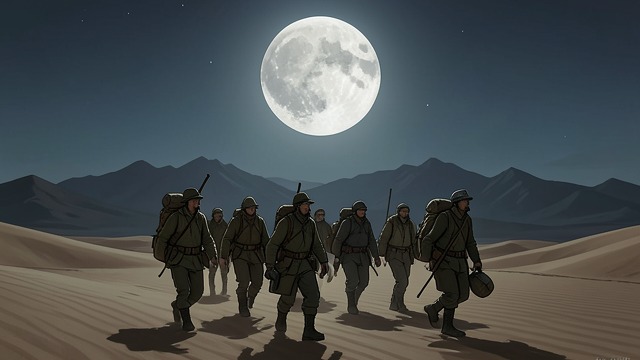
Beauty before hardship
A deceptive beginning
Under the moon, the sand resembles a shining surface, and the travelers move steadily toward the distant mountains. The stillness gives Shasta a short-lived sense that the crossing may be manageable.
Fatigue gathers
As the moon disappears, darkness makes the journey harder to read. The repeated sounds of hooves and tack mark time, while cold, thirst, and weariness slowly replace the first excitement.
The desert’s apparent emptiness is itself a pressure: there are few landmarks and no easy refuge. The travelers must keep moving through a landscape that offers no visible sign of progress.
Heat and Bare Feet
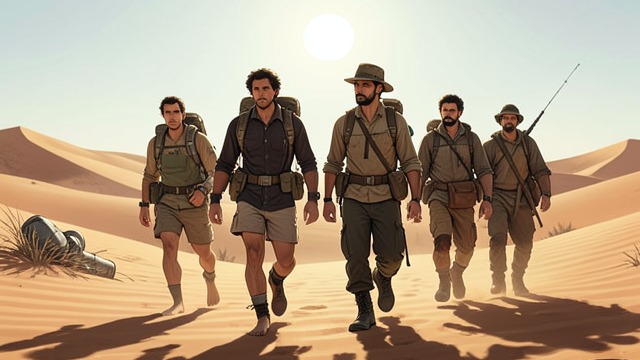
The ground becomes hostile
A bodily limit
The sun turns the sand into a source of painful heat, and Shasta cannot continue walking barefoot. Aravis has shoes, while Shasta has to remain mounted despite the planned alternation between riding and walking.
Small supplies
At a brief stop beside a rock, the travelers eat and drink only a little. Their provisions cannot remove the strain; they can only delay the point at which thirst and exhaustion become disabling.
Physical differences become practical problems, not abstractions. The journey requires the group to notice one another’s limits and adjust its plan without wasting the scarce time or water it needs to reach safety.
The Valley in Darkness
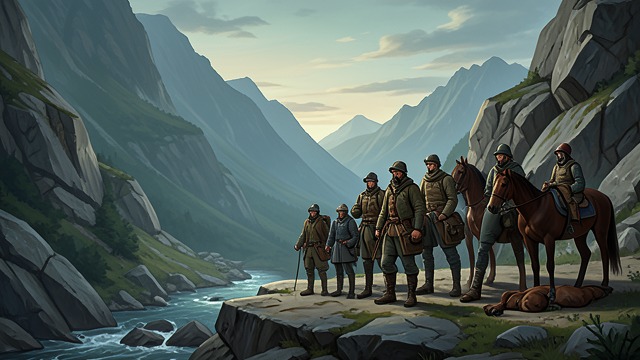
A difficult refuge
Finding the descent
After a long day, the group sees the slope and rocky walls of the hidden valley. The route is steep and winding, and the horses are close to exhaustion before the first dependable stream appears.
Water at last
A trickle becomes a stream and then a river. The travelers drink and rest beside the pool, grateful for a landscape that offers grass, water, and shelter from the open sand.
Relief arrives only after the crossing has consumed most of their strength. The valley saves them from immediate thirst but also makes the danger of stopping visible: they still need to reach Archenland before Rabadash.
Self-Command After Captivity
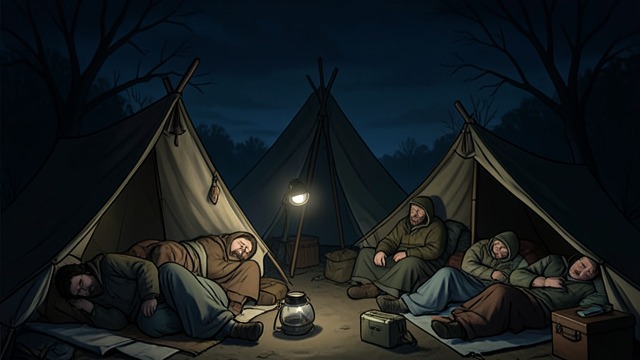
Freedom requires discipline
A lost morning
The exhausted group sleeps longer than intended. Aravis wakes and realizes that the delay may cost them the lead they need over Rabadash.
The difficult choice
Bree wants food and rest, while Hwin suggests that free horses should be able to continue for Narnia. The narrator connects Bree’s hesitation to a habit formed by slavery: when force disappears, self-direction may be difficult to recover.
The conflict is no longer simply between travelers and desert. It also lies within a group learning to govern itself, where courage means acting without a master to impose the next step.
before the fugitives leave the Tombs
the first hours of the night crossing
the first day of travel across the desert
the night the travelers find the hidden valley
the morning after the travelers sleep in the valley
